Rome Festivities

The festivities of the city of Rome in Italy. Not only Roman Catholic celebrations, but also Jewish and folkloric ones, for a tradition that has been going on for thousands of years.

Miniaturize Yourself in Italy!

Italia in Miniatura, or Miniature Italy, is a fun theme park for all ages that will miniaturize you!

Palio of Siena Tragedy

Should the Palio of Siena be suppressed? And what should happen to hippodromes?

Sicilian Cassata Recipe

A classic from Italian culinary tradition, a Sicilian dessert to prepare at home.

Italian Eco Friendly Aperitif

Sugheritivo is the eco friendly aperitif en-vogue in Italy since 2011. Bring a cork in, get a free glass of wine!

Wonderful Ischia Thermal Spas

Ischia has it all, and its thermal baths are a gift from the gods since ancient times.

Monday, December 26, 2011

Christmas in Italy

Christmas in Italy has already changed a lot during the years. Many years ago there was no Christmas tree tradition, and a nativity scene was the only thing that was done. For some reasons, maybe the pro-American feelings that undoubtedly pervade the whole country, or maybe because is an easier decoration to prepare, the tree has become one of the most poignant Christmas images in Italian peninsula. Nowadays in Italy you most often find a nativity scene besides a Christmas tree.

Spending Christmas in Italy means to discover many traditions of the past, mostly tied to the countryside and the Catholic religion. These Holidays are paced by the various religious and pagan festivities that chase each other and come to a conclusion with Epiphany on January 6. Today is Saint Stephen, an it's a holiday. New year's eve and January 1st are also holidays. The greater majority go to work during the days in between these festive days, however some take vacation days to have a long weekend. Schools in Italy close on December 23 and open again on the first school day after January 6.

Epiphany is a small Christmas for children. It is a festivity tied to when the three wise kings arrived to Bethlehem to adore the newborn Jesus. Indeed epiphany means revelation. In this day Italians hang a stocking at the fireplace and await the arrival of Befana to fill them up with candies and small presents for good kids, and charcoal for bad kids. Befana is the name of the old and ugly lady that comes flying on a broomstick to distribute presents to kids. She embodies this festivity since the legend tells that when the wise kings knocked on her door asking for the direction to Bethlehem, she helped them, but refused to join their journey as she was busy with home chores. She later regretted it, and after gathering some presents for baby Jesus she immediately started chasing after the wise kings. But no matter how hard she looked for them, she was unable to find them. So she decided to look for baby Jesus in each house where there was a new born, and leave a present to each one in case that was going to be the one.

Italians are also very traditional, and never fail to celebrate Christmas with their family. They have a saying "Natale coi tuoi, Pasqua con chi vuoi", Christmas with your family, Easter with whomever, which gives the sense how this festivity is much more felt than Easter. Sometimes it is hard to stay with your and your spouse's family. Therefore Italians employ Christmas Eve as a good occasion to stay with one side of the family, spend Midnight there, which is officially Christmas, then the next day is spent with th eother side of the family.

There is little moving around during these festivities, as the majority stay at home. Some use these days as a holiday period, visiting the Alps or seaside localities with thermal spots such as Ischia. But this is not typically Italian. Therefore if you want to visit Italy after Christmas day, you will find quiet cities, especially on the 26. The days approaching New Year's Eve are a little busier, but calm is soon restored on January first until the Befana.

Saturday, December 10, 2011

Comacchio, The Small Venice


Comacchio is the most original and fascinating historical center of the mouth of the Po river. Its history is inextricably linked to the flourishing of activities such as fishing, lagoon fish breeding, processing of sugar cane and the production of salt, which is still well developed. Its hallmark is the Trepponti bridge in addition to other important monuments such as the San Cassiano cathedral, the Portico of the Capuchins and the ancient Sanctuary of Santa Maria in Aula Regia.

Comacchio is also called the small Venice, because the city was founded on the canals of the mouth of Po River Park, famous for the Lidi of Comacchio, which are very busy in summer.
But apart from the sea and the beauty of Emilia Romagna near Ferrara, Comacchio is a town to be discovered, even while surfing through the canals of the islands that comprise it.

Places of interest
Trepponti - This is the symbol of Comacchio, five large staircase on the channels that accommodate the passing tourists.

Bellini Building - This building is located near the Bridge of Sbirri and is a large building that houses the Art Gallery and many temporary exhibitions

Cathedral of Comacchio - In Piazza XX Settembre, is the Cathedral of St. Cassian, cathedral city

Clock Tower - This tower is one of the main monuments of the city and is located in the beautiful Piazza Ugo Bassi

Excursions and tours
There are many possible itineraries and excursions in Comacchio, but one that I recommend is the boat ride on the "Batana" (typical boats of the area). To take advantage of this free service, you must go to the docks in front of the old fish market.
Do not forget the itineraries of Comacchio on foot, by bicycle or by boat ride on the Po mouth.

Another important excursion that you have to take into consideration is the former saline extraction facilities. Large portions of salt lagoon that were abandoned and are now the safe landing for a community of hundreds Flamingos. These spectacular birds started populating the area after all salt extraction work ceased, which gave the area the deep serene and quiet character that Flamingos need to live and thrive.

Thursday, December 1, 2011

Trieste Guide


Trieste is one of the most beautiful Italian cities. It is spectacularly placed in front of the sea, nestled foothills. The beautiful nineteenth century buildings that line the waterfront testify to a past of great maritime traffics with the Austro-Hungarian Empire. Trieste has always been, and still is, a frontier town, both culturally and geographically: Slovenia is not far from the Carso heights leading there, and from where the Bora wind sweeps the city.

It is the capital of Friuli Venezia Giulia with about 210,000 inhabitants. Trieste is a fascinating and aristocratic city. It is the last city of northeast Italy, the extreme southern part of Central Europe, the first city in the new Europe at the same time. The three notations enable us to understand a rich fabric of history, art and culture linked to the world of technology and scientific research, and to nature that here shows only some of its most fascinating phenomena.

Really, you can not understand Trieste at a glance. Viewed from the sea, it appears in a semicircle between the promontory of St. Andrew, where the lantern rests, and Ripa. The bank is barricaded by a long row of houses and buildings. The row is interrupted by a flight of streets that are lost within the city. Only toward the Portonuovo, between two rows of buildings, the Grand Canal opens a hole in the heart of the city for about 300 meters, forming one of the most characteristic spots of Trieste: the casual walker is startled by the sudden view of ships in the middle of the city, unexpectedly appearing to those coming off the main street going into the Pontegrosso, Canal Grande, and the likes.

At the bottom of the canal stands a Roman-style church, St. Anthony, beside the church of the Greek schismatics, St. Spyridon in purely Byzantine style. Viewed from the sea, therefore, Trieste appears almost tiny. Two hills, springing from the heart of the city, San Giusto and San Vito, make believe here are two possible limits to the city. On the contrary, after climbing those two hills, the city rushes to occupy the valleys that open behind, fending a new assault on to other flanking hills, then continuing to grow between walls of rock, and the jolly vegetable gardens and groves. Therefore, there never is a single point of the city from which the observer can embrace the whole city.
According to many visitors, few Italian cities have such natural beauties as Trieste. Due to its enviable position, Trieste has always attracted many artists, who searched for their inspiration in its purple sunrises and fire sunsets. Byron, Charles Nodier, Carducci, are just a few.

Trieste shows the changing of times with ruins that attest to its Roman origins, its alleys in the old neighborhoods, the remains of its medieval walls, and towers, the patrician houses, now poor, battered, but still with a noble character, the legends carved on nude rocks, the wells in the courtyards, and the preserved tombstones with Latin inscriptions.

The city has experienced long years of political extremism, which has sometimes been national irredentism, sometimes a real clash of civilizations. The definitive passage to Italy in 1954 is still alive in the memory of Trieste, during a time when the return to the homeland appeared uncertain. Almost by a miracle in Trieste, just like in other border cities of transit, the constant psychological tension, dictated by the many political upheavals and uncertainties, refined intellectual sensibility and produced fine reflections of intellectuals born here, or that here found their creative habitats: James Joyce, Rainer Maria Rilke, Umberto Saba and Italo Svevo. The legendary Cafes of Trieste are imbued with memories of great conversations and discussions that took place within them. They happened at a time when politics and art, literature and philosophy were discussed in various languages, in a twilight world with an uncertain future that was darkly looming ahead.

Friday, November 25, 2011

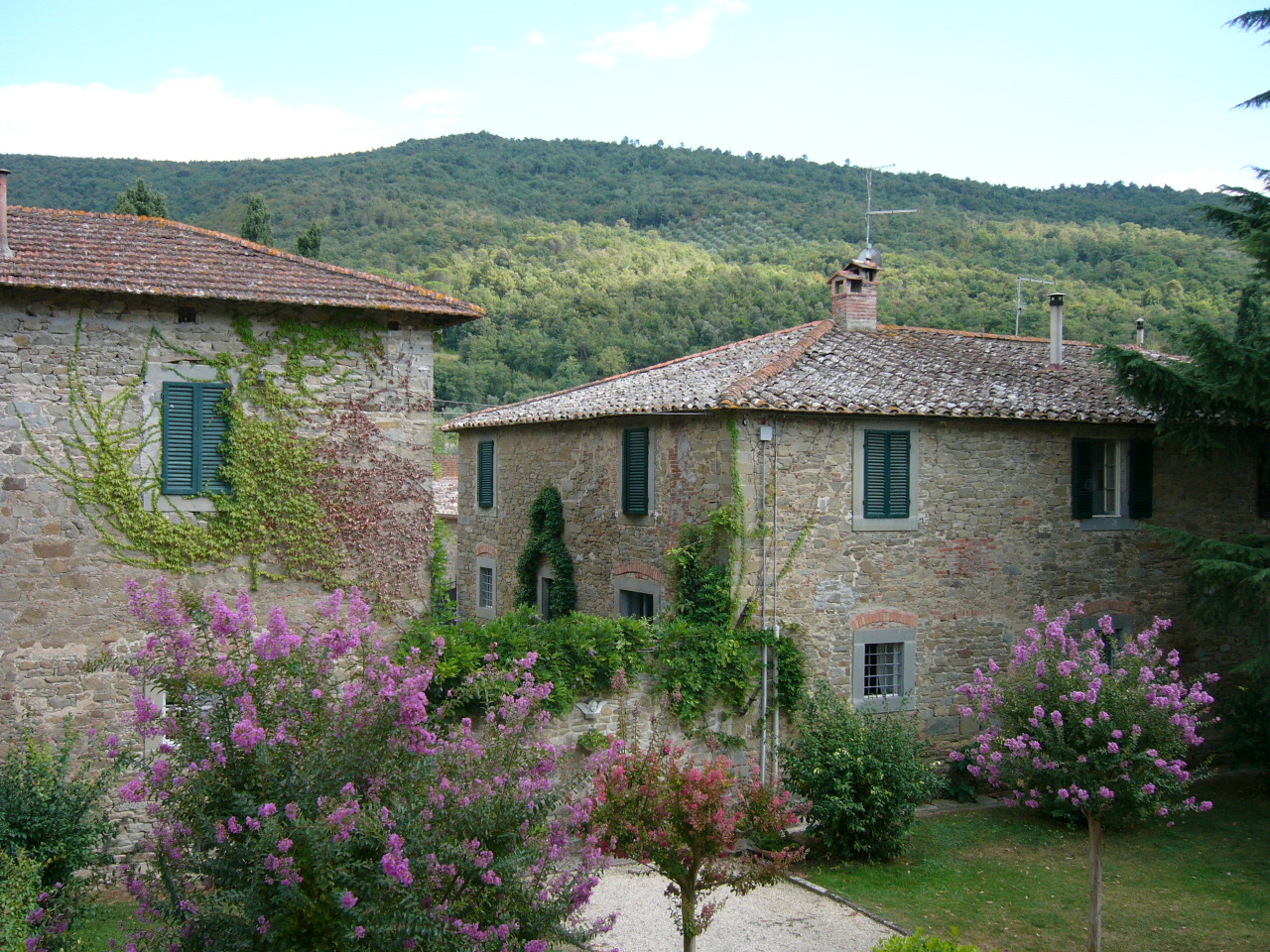
Tuscan Villas


I love Italian villas. They are so charming and full of romance. I am sure you know what I am talking about. The clean and fresh Liberty style of the Twenties, the earlier Neoclassic with its sweeping heights protruding to the sky, the Renaissance with its pastel colors and Italian gardens, the Medieval period, with its brick and stone walls all have a great charm.

But there is a kind of villas that I love the most. Perhaps it does not belong to any specific architectural style, or perhaps to the rural one, if such style exists. At any rate, I am talking about Tuscan villas, those rising in the middle of the luxuriant countryside on top of panoramic hills. Surrounded by well kept fields, woodlands, and water bodies, these villas have a very humble past, one deepening its roots in the land they were built on.

I am indeed charmed away by peasant farmhouses, those with stone walls, comfortably sitting on a green estate with their wide presence and low rising roofs. Large families of laborers lived on the first floor, while on the ground floor the stables hosted cows and horses, the tractors of the past. The floor dividing the stables from the living quarters used to be made of a layer of cotto tiles held by wood pillars and lines of studs. The relative thinness of such layer was achieved on purpose to allow the heat of the stables to flow to the upper floor. A thick ceiling would have isolated the heat in the stable.

These villas had not many comforts, and the Sunday morning bathing, religiously carried out prior to going to church, took place in the stables inside a vat, as this was the warmer room of the house. The fireplace on the first floor was the heart of the house. The large dining room and kitchen was built around the fireplace. It is here that most of the daily life took place. The fireplace was used to cook, it heated the dining room, and often accommodated six or more people inside during colder nights. Here the large family, and often neighbors, gathered to chat and carry on petty hand works and crafts impossible to do during the daylight time, which required to be in the fields. Wood and straw works served to the production of chairs, hats, kitchen utensils and to repair work tools. Stories and local news were told while manual work was carried out, and perhaps this is also how couples could meet each other and create new families.

Bedrooms did not have fireplaces, and the freezing cold beds where warmed up using bed warmers filled with ambers. The mattress was filled with dry corn leaves, and you can imagine that beds catching fire was not a rare happening!

Each time I enter into Tuscan villas I can feel the past. Although nowadays many were renovated and include all comforts, the original soul of the place is still present. At times I like to visit the ruins of an old farmhouse. At first I think it is a pity it was not restored as many other were, but then I can see the signs of abandonment and rediscover many original traits of a rural life that completely disappeared in Tuscany and Italy.

Monday, November 14, 2011

The Day After....Berlusconi


Traveling through a country does not only involve the often superficial activity of moving from place to place watching the world around you as if you were in a zoo. The real traveler, though short his visit may be, always tries to get to the ore of things, and however a hard job this is, it rewards her much in the end.

Traveling through Italy, or any other country for that matter, also involves talking about its political happenings. Even more so if you are armchair traveling while reading my subjective and instinctively written articles. It is the right way of traveling as it adds a third dimension to your point of view, giving you the instruments to get a rounder picture even on more ephemeral subjects I will be addressing in later posts.

The big news of these days is that, after Papandreu's leave of office in Greece, Berlusconi, Italy's (former) prime minister, resigned from his post to give way to a technical government headed by Mr. Monti.

What is a technical government? Non-Italians like me might have a hard time grasping this concept at first. It is a concept that speaks of Italian culture. This type of government, literally, is one set in place to "get the job done". Yes, it sounds absurd. What are non-technical governments there for, then?

First of all, governments elected through regular elections, such as the one that just fell in Italy, are supposedly formed by politically prepared people that have good leadership. They are managers, but need (economy, medicine, education, transportation) expert consultants to run the show. During the so-called technical government, one that was not elected by the Italian people but appointed by the leaving government and the President of the Republic, you just have these expert consultants running the show. It's like a company downsize, when marketing and PR are trimmed to fuel the R&D department.

Berlusconi's government was really (REALLY!) big in marketing and PR, however lacked much expertise, and the ability to pull it together into a synergistic strategy. The mix was composed of very young ministers, of whom many coming from the show business, others without a properly developed cultural background, but most importantly of frail alliances that always threatened the stability of the government and brought to a stalling legislative motor.

The Lega Nord party especially leveraged on its small number of seats that nevertheless allowed Berlusconi to remain the Prime Minister of Italy, while pushing towards its pet interests at the expense of the whole country.

This brings about the new electoral law that 1.2 million Italians dearly desire to the point of subscribing a referendum request on this matter. You see, in Italy at this stage any party is a big box that gets voted, then filled with all sorts of people. You elect a brand, not the people representing you. This was supposed to create stability in a country that up to the end of the 20th century had had more than fifty governments in less than fifty years with hundreds of parties represented. However, stability (and democracy) was compromised by allowing medium parties to partner up with smaller ones, so to reach the minimum required number of seats to gain the majority and govern. Problem is, these parties often come from very different ideological backgrounds. As a result, and to much dislike of electors, if one wants to vote for the left wing alliance, she will end up giving her vote also to center-right parties participating into the alliance. And if that alliance wins, then you will probably see "your" government act in favor of ideologies totally foreign to its original intents. And this is done just to foster stability (or keep their well-paid seat, as they say in Italy). Otherwise their political allies might abandon the crew and let the boat sink (as Lega Nord continuously threatened to do).

On the part of Italians, Berlusconi's demise was reason to carousel along the streets of many cities, as if Italy had won the World Cup. The vast majority of Italians could not stand his empty promises served on a plate decorated with sexism, racism, egocentrism, bad manners and bad taste anymore. On my part, I will remove the poll on this blog with the question "Do Italians Deserve Berlusconi?" and give it a resounding "no" as an answer.

Tuesday, November 1, 2011

All Saints Typical Italian Sweets


All Saints Day is celebrated on November 1 around the world the. It is a big celebration for Christianity, followed by November 2, the All Souls Day, a Christian event that traces its roots in ancient times.
Talking about seasonal cooking, every Italian region has tied these two celebrations to the table. For the most part these are recipes based on seasonal produce such as pumpkin, chestnuts, cabbage, pork, vegetables - especially beans and peas and and dried fruit. In Liguria, the custom is to eat chicken for All Saints to live up to the proverb "All Saints without beak, Christmas will be poor", probably tied to the fact that if you didn't have chicken to eat on All Saints day, by the end of December you would have had little food on your table.
The desserts, however, are certainly the most famous ritual food: in fact, each region has its typical sweet with a name recalling the celebrations.

Bustrengolo from Umbria
Ingredients: 350 g of corn flour, 100 grams of sugar, 50 grams of pine nuts, 100 g of raisins, 4 tablespoons extra virgin olive oil, 1 pinch of salt, 2 apples

Preparation:
Boil a large pot with 1 quart of salted water and add the flour as to make a polenta. Add the oil and mix together. Cook for about twenty minutes, then add the sliced apples, raisins, pine nuts and the sugar. Remove from heat and pour the mixture, which should be rather soft, on a buttered cake mold in a layer about 3 cm thick. Bake in a heated oven at 180 degrees and cook for about half an hour.
It should be eaten cold.

Colva from Puglia
In Puglia, particularly in the areas of Foggia and Barletta, it is typical of the Day of the Dead. The preparation of this cake is made of wheat and pomegranate.

Ingredients:
The kernels of a pomegranate, 1 can cooked corn, 150 grams of chopped walnuts, 150 grams of chopped almonds, white grapes, 100 g dark chocolate, sufficient mulled wine

Preparation:
Drain well the cooked wheat and place it in a bowl. Mix it with the pomegranate seeds, walnuts, almonds, the seeded and peeled grapes, chopped dark chocolate and add just enough mulled wine to mix all the ingredients into a smooth mixture. Serve in bowls.

Castagnaccio from Tuscany (for 6 people)
400 g of chestnut flour, Enough water, enough olive oil, 30 grams of raisins (soaked in warm water), 30 g of pine nuts, 3 tablespoons of sugar, 1 pinch of salt, 1 tablespoon rosemary

Preparation:
In a bowl mix the water with chestnut flour and sugar stirring with a whisk to prevent lumps. Your batter consistency should be quite liquid. Oil a cake mold of 25 cm in diameter with extra virgin olive oil and pour the mixture, pour on top a thin line of olive oil sufficing for two table spoons and finally sprinkle with pine nuts, raisins and rosemary. Bake in a heated oven at 180 degrees for about 40 minutes until the surface becomes dry and opposes resistance when pressed with a finger.

Share

Twitter Delicious Facebook Digg Stumbleupon Favorites